Dryer Vent Cleaning in Bridgewater, NJ
AMG Duct Cleaning Bridgewater clears lint from the whole dryer vent, from the connection behind the machine to the hood or roof cap outside, in the split-levels, colonials, two-family houses and townhomes around Bridgewater. The NFPA lists failure to clean as the leading cause of home clothes dryer fires, and a vent packed with lint also stretches every load into a longer one.
Where the laundry sits decides almost everything about the vent. In the ranches and split-levels built around Bridgewater in the 1960s and 1970s, the dryer is usually in the basement or a lower-level laundry, and the vent runs a short way to the rim joist and out the side of the house. Two-story houses from the 1980s and 1990s in Bridgewater, Bernards and Warren often put the laundry on the first floor or next to the bedrooms, which means a longer run through a joist bay, or a climb through the attic that ends at the roof.
Attached housing adds its own pattern. Bedminster has more townhomes than detached houses, and The Hills, the planned community that crosses from Bedminster into Bernards, adds condominiums and other attached homes on both sides of the line. In those units the vent may climb a chase to the roof or run out a wall where several neighbors' hoods line up. In the two-family houses of Bound Brook and North Plainfield there can be two dryers and two vents on one building, sometimes a few feet apart. Each layout clogs in its own place, and the crew cleans it accordingly.
Basement laundries and short runs
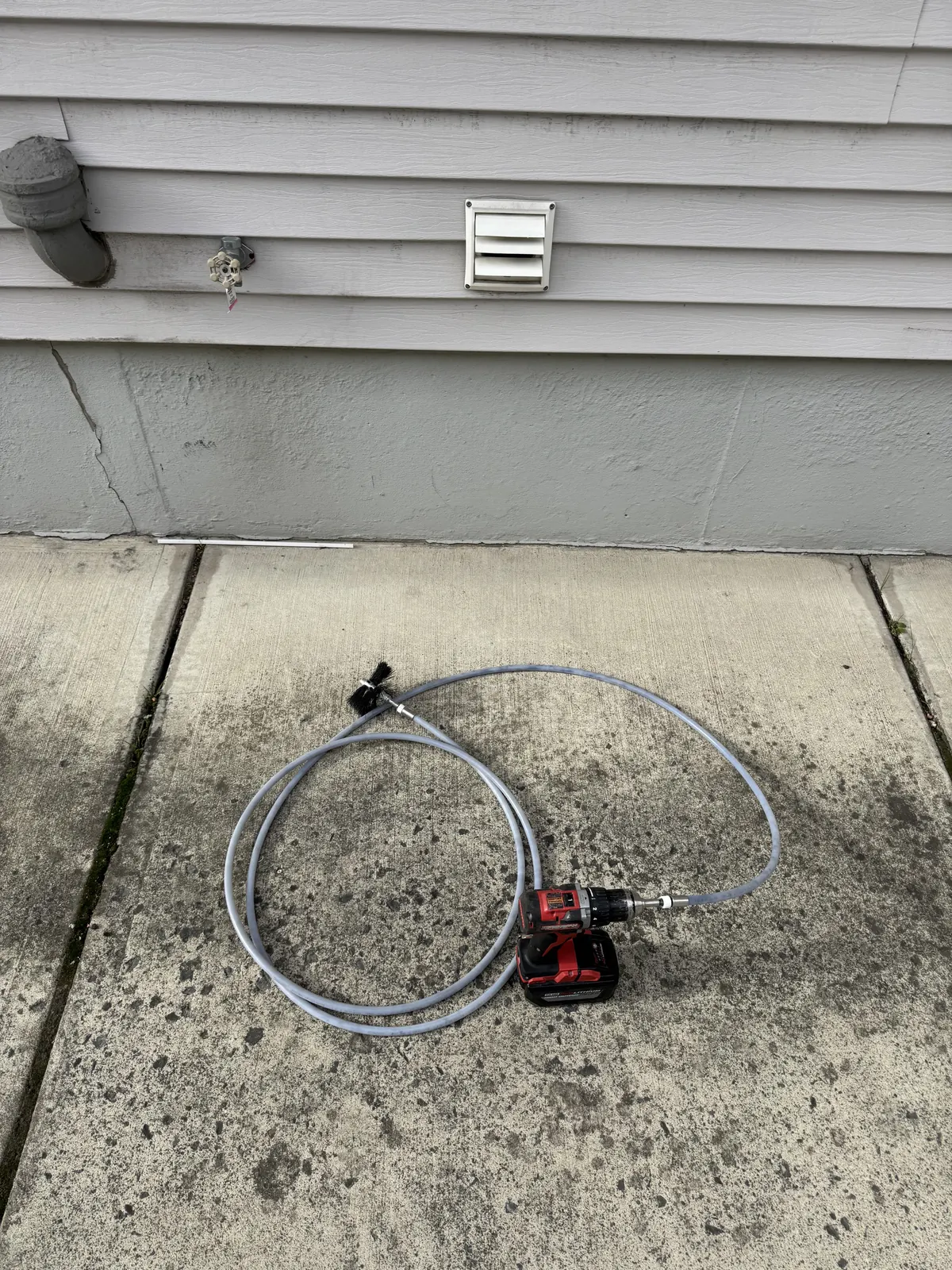
A short basement run looks harmless, and that is why it gets ignored. Lint collects at the first elbow behind the dryer, in the transition hose that gets crushed when the machine is pushed back against the wall, and at the hood, where a flap coated in lint sticks half open. On the older split-levels the vent often exits low on the foundation wall, close to the ground, where leaves, snow and mulch pile up against the hood.
The cleaning covers the full length anyway. The dryer is pulled out and disconnected, the transition hose is checked and flagged for replacement if it is plastic or thin foil, and the run is brushed and vacuumed from both ends. The hood flap is cleared and tested with the dryer running, since a flap that swings open freely is the easiest check a homeowner can repeat between visits.
Second-floor laundries and roof caps
When the laundry is upstairs, the vent gets longer and turns more often, and a vertical section to the roof holds lint the way a flue holds soot. Damp lint settles in the low spots of a horizontal run through a joist bay and hardens there. A roof cap fitted with a screen, which the residential code does not allow on a dryer termination, mats over with lint and chokes the whole system.
Most of these runs can be cleaned from the laundry end with rotary brushes and air on flexible rods long enough to reach the roof, while a second technician watches the cap. The cap itself is cleared from the roof only when the pitch and the weather make it safe. Some long runs were built with a booster fan partway along, and the crew checks that it still runs and that lint has not caked its housing. If a run is too long, turns too many corners, or was built with ribbed foil inside a wall, cleaning helps for a while, but dryer vent installation is the lasting fix.
Townhomes, two-family houses and shared walls
In attached housing, several dryer hoods often line up along one wall or cluster on one roof, and the owner of a unit may not know which one is theirs. The crew confirms it with the dryer running before any cleaning starts, so the work goes into the right run. Association rules can govern ladders, roof access, work hours and parking, and those are easier to settle before the day than at the gate. In stacked condominiums a vent may share a chase with others, and the work stays on the run that serves your dryer.
A two-family house in Bound Brook or North Plainfield puts two households' laundry on one building. Each vent is cleaned and tested on its own, and where the two hoods sit close together the crew checks that each flap closes, so one dryer is not blowing lint toward the other's opening. Tenant schedules decide the timing, and both units can be booked into one visit.
Signs a dryer vent is overdue
The NFPA's advice is a yearly cleaning of the vent pipe, and an earlier one whenever drying takes longer than it used to. Other signs are clothes that come out hot and still damp, a laundry room that feels warm and humid, a scorched smell, lint gathering around the outside hood, and a hood flap that hardly lifts when the dryer is on. In winter, check that snow has not buried a low hood, a point the NFPA makes as well. A vent that clogs again within months of a cleaning usually has a layout problem, and that is worth fixing instead of cleaning around it.
Gas dryers add one more item: the NFPA advises having someone qualified inspect the gas line and connection to confirm they are intact and free of leaks. AMG, veteran owned, licensed and insured under registration NJ HIC 13VH13654300, schedules dryer vent work 8 AM to 8 PM, 7 days a week. Looking at the run and pricing it costs nothing, and when the laundry sits near the furnace, air duct cleaning can share the visit.
What is included
- The whole run cleaned, dryer connection to outside hood
- Transition hose checked, and flagged if plastic or thin foil
- Rotary brushes and air sized to the vent diameter
- Elbows and low spots in long runs cleared of packed lint
- Roof caps inspected up top when the pitch allows
- Hood flap cleared and tested with the dryer running
- Your hood confirmed among the neighbors' on shared walls
- Airflow at the termination checked before and after
Questions and answers
How often should a dryer vent be cleaned?
Once a year is the NFPA's baseline, and sooner if loads start taking longer to dry. A household that runs the dryer every day, or a long run up to the roof, tends to clog faster than a short basement vent. The walk-through shows you how much lint came out, which is the best guide to the next date.
Our townhome's dryer vents through the roof. Can you clean it?
Yes. Most roof runs are cleaned from the laundry end with rods long enough to reach the cap, and the cap gets a look from the roof when the pitch and the weather allow. Mention any association rules about roof access when you book.
Clothes take two cycles to dry. Is it the dryer or the vent?
Check the vent first: go outside while the dryer runs and see whether the flap opens and air pushes out firmly. Weak airflow at the hood points to the vent, while strong airflow with damp clothes points to the dryer itself. A cleaning settles it, since airflow is tested before and after.
We own a two-family. Can both units' vents be done together?
Yes. Each run is cleaned and tested separately, and the crew confirms which hood belongs to which unit before starting. Let the tenants know the time, since each dryer has to be pulled out and disconnected.
Is a foil or plastic hose behind the dryer a problem?
Yes. The NFPA calls for rigid or flexible metal venting to keep air moving, and plastic or thin foil hose crushes easily and traps lint. The crew points it out, and swapping it for a listed metal connector is a small job.
More questions and answers about our work
Dryer Vent Cleaning across the Bridgewater area
We provide dryer vent cleaning in the Bridgewater area. Choose your town for local details.
Ready for cleaner air?
Tell us about your home and get a free estimate.