Smoke Chamber Repair in Bridgewater, NJ
Smoke chamber repair fixes the brick throat above a masonry fireplace, where gaps, loose mortar and rough ledges collect creosote and leak heat. AMG Duct Cleaning Bridgewater handles this work on the fireplaces of Bridgewater and the towns around it, and it usually starts with a line on a sweep report that nobody expected.
You may have found this page because a sweep used a phrase you had not heard before. The smoke chamber is the space that starts directly above the damper and narrows up to the flue, and you cannot see it from the room. On a masonry fireplace in Watchung or Bridgewater from the 1950s or 1960s, or on a prewar house in Bound Brook, it was built by a mason working in tight quarters, and whether it was ever smoothed varies from one house to the next.
The questions below follow the usual order: why the sweep mentioned it, what parging is, which fireplaces around here are the likely candidates, how much can be reached, and what to do with a fireplace that has been closed for years. If your house has a factory-built fireplace, the kind common in townhomes and in many newer houses in Warren and Bernards, none of this applies, because that unit has a metal firebox and pipe and no masonry chamber. Chimney repair covers those.
Why did the sweep mention the smoke chamber?
A sweep brings it up when the brush and the light show walls that are open, flaking or stepped, since that is the one part of the system a brush cannot put right. During a chimney cleaning, the smoke shelf and the chamber get cleared along with the flue. Once they are clean, the condition of the masonry shows: open joints, missing patches of old coating, bricks stepping inward like an upside-down staircase, or a ledge heaped with fallen mortar.
The note is worth following up, and worth asking about. Ask to see the photograph, and ask what specifically is wrong: a gap, a crumbling section, a rough surface that traps creosote. Those are different conditions. An open gap through the masonry calls for a repair before more fires, while a rough but tight chamber may be something to watch. Heat and flue gases belong inside the flue path, and on an interior chimney the framing sits only inches beyond that brick.
What is parging, and why not use ordinary mortar?
Parging is a smooth coat of refractory mortar troweled over the chamber walls, and ordinary mortar is the wrong choice because it is not made for fire heat and flue acids. New Jersey's residential code gives a new smoke chamber a smooth inner parge of refractory mortar to ASTM C199. The rule is written for fireplaces being built, and many of the ones around Bridgewater predate it, but the material choice carries over to any repair.
The aim is a chamber with no open joints and no ledges. Smooth walls shed creosote instead of holding it, draw better on a cold start and leave fewer places for embers or heat to find a way into the wall behind. The chamber has to be swept and scraped clean first. A coat applied over glaze or soot will not bond, and it falls back onto the shelf within a few fires, sometimes bringing more with it.
Which fireplaces around Bridgewater are most likely to need it?
Masonry fireplaces from the first building wave and earlier are the likely ones, since their chambers have had sixty years or more of heat, creosote and water. Watchung's biggest building decade was the 1960s, and houses of that era were often built with a fireplace on a stack that also carries a furnace or boiler flue. Green Brook, Middlesex and the older sections of Bridgewater followed the same pattern. An occasional fire still leaves deposits, and a shelf gets wet whenever the top of the flue lets rain in.
Prewar houses are their own category. North Plainfield has the oldest housing of any town served from here, by Census estimates, and in a Washington Park house the fireplace may date from a time when it was a main source of heat. Those fireplaces often burned coal, may have been closed off and reopened more than once, and in some cases have chambers shaped for a different fuel than the one used now. Around the Basking Ridge historic district, the older houses bring the same mix of age and uncertain repairs.
Can a smoke chamber be repaired from inside the fireplace?
Usually, yes, since the chamber is reached through the damper opening above the firebox, although the width of that opening limits what can be done from below. A small throat or a damper frame set into the masonry makes the work tighter, and a damper in poor shape may have to be dealt with first, so chimney damper repair often joins the same scope. Nothing outside the firebox has to be opened on an ordinary job, which is a relief to anyone with a finished family room.
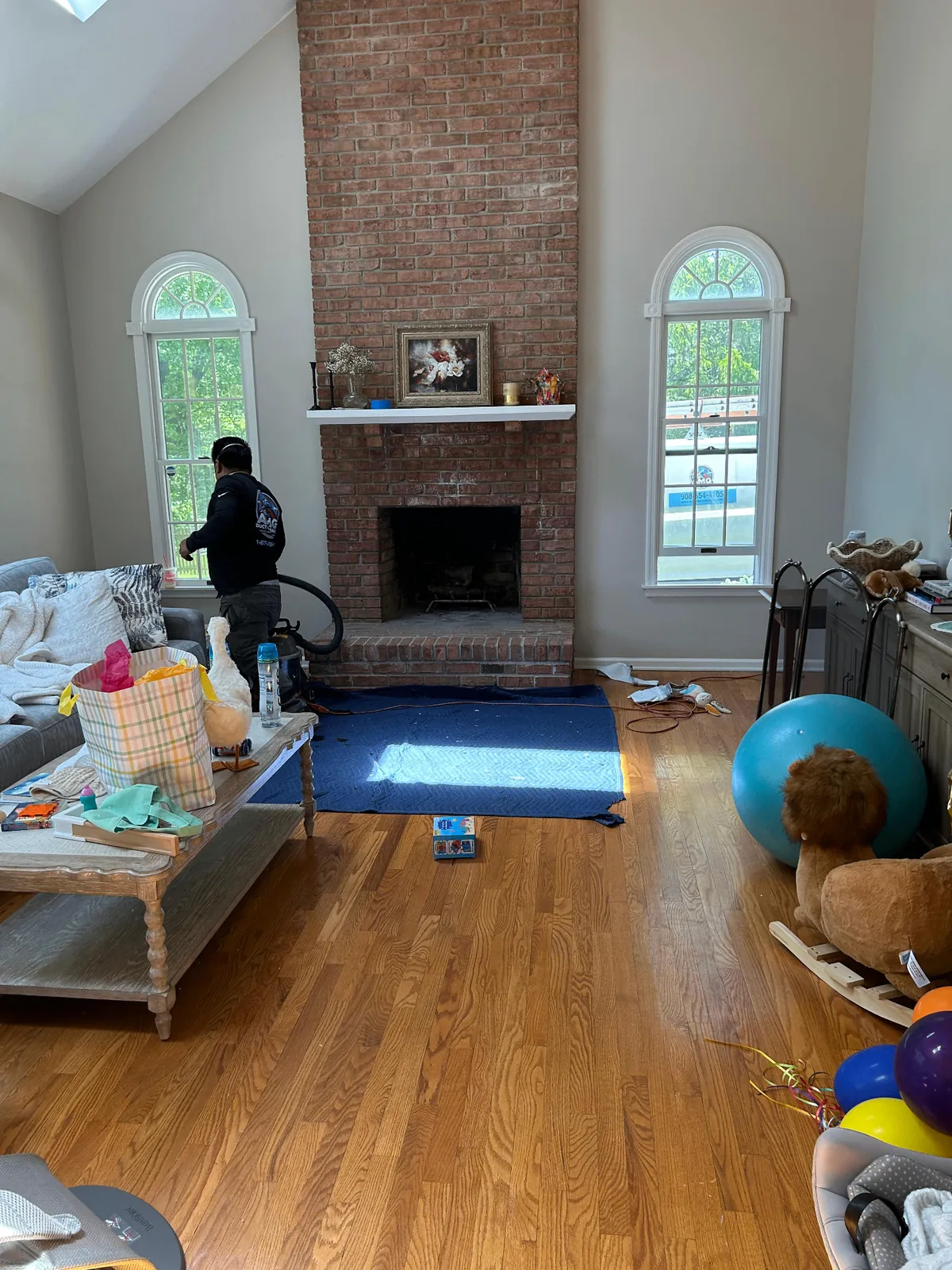
Inside the room, the setup follows the same habits as a sweep: the hearth is covered, a vacuum runs at the firebox and whatever comes down leaves in bags. The repair leaves a clean, even surface that a sweep can brush in later years. A top-down look from the roof is still part of the job where the roof can be walked, because the crown or cap that let the water in is what the repair has to answer. A chamber fixed under a leaking crown will start coming apart again.
What should happen before a closed fireplace is used again?
A fireplace that has sat closed for years should be swept and inspected from the damper up before anyone lights it, with the chamber included. Closed fireplaces hide nests, rusted dampers and mortar that dropped onto the shelf long ago. A boarded-up opening in a Victorian can hide a chamber with a hole in it, and an old patch may have been done with whatever was on hand.
The answer may be that the chamber is fine, in which case you hear that. If repair is called for, it appears on an itemized estimate, free of charge, with photographs next to each line. AMG, licensed and insured and veteran owned under NJ HIC 13VH13654300, books this work 8 AM to 8 PM, 7 days a week. A reopening is easiest to plan in summer, when the weather does not limit the work at the top of the stack. If a flue tile turns out to be cracked as well, chimney flue repair follows the chamber.
What is included
- Flue, shelf and chamber swept before the masonry is judged
- Photographs of the chamber walls for your review
- Open joints, ledges and old coating checked
- Fallen mortar and debris cleared from the smoke shelf
- Gaps closed and loose sections rebuilt
- Walls parged smooth with refractory mortar
- Damper fit and movement checked at the same time
- Drop cloths at the hearth and a vacuum at the firebox
Questions and answers
Does every masonry fireplace need its smoke chamber parged?
No. A tight chamber in good shape can go on working without it. Parging earns its place when the walls have open joints or heavy ledges. Ask for a photograph and a plain reason, tied to your own fireplace.
We only light a fire a few times a winter. Does this matter?
It can. Light use means less creosote, but the gaps stay open, and a cold, seldom-used flue still leaves deposits. The risk depends on what the masonry looks like, so go by the inspection and not by how often the fireplace is lit.
How much does smoke chamber repair cost around Bridgewater?
The price follows the size of the chamber, how much buildup comes off first and how far the damage goes. Filling a few gaps is less work than coating the whole chamber. The estimate is free and lists the chamber on its own line.
How long before we can use the fireplace after parging?
Follow the curing and first-fire instructions for the mortar that was used. Small fires first is the common advice, so the coating dries through slowly. If you have a date in mind for a fire, mention it when you book.
Can a smoke chamber cause smoke in the room?
It can add to the problem, since stepped walls slow the smoke while the flue is still cold. A blocked flue, a short stack or wind on the Watchung hillsides are equally likely. The inspection checks these together.
More questions and answers about our work
Smoke Chamber Repair across the Bridgewater area
We provide smoke chamber repair in the Bridgewater area. Choose your town for local details.
Ready for cleaner air?
Tell us about your home and get a free estimate.